Reduces material waste up to 35%.
· Validated against mixed RIP workflowsComputer vision · wide-format print
AI that catches banding before the roll winds.
PrintApex is a computer-vision defect-detection engine purpose-built for wide-format print. A single ResNet-18 variant runs on an edge device, ships structured JSON defects, and routes webhook alerts — measured at 95%+ accuracy on banding, color shifts, and misregistration.
- Detection accuracy
- 95%+
- Edge footprint
- < 200MB
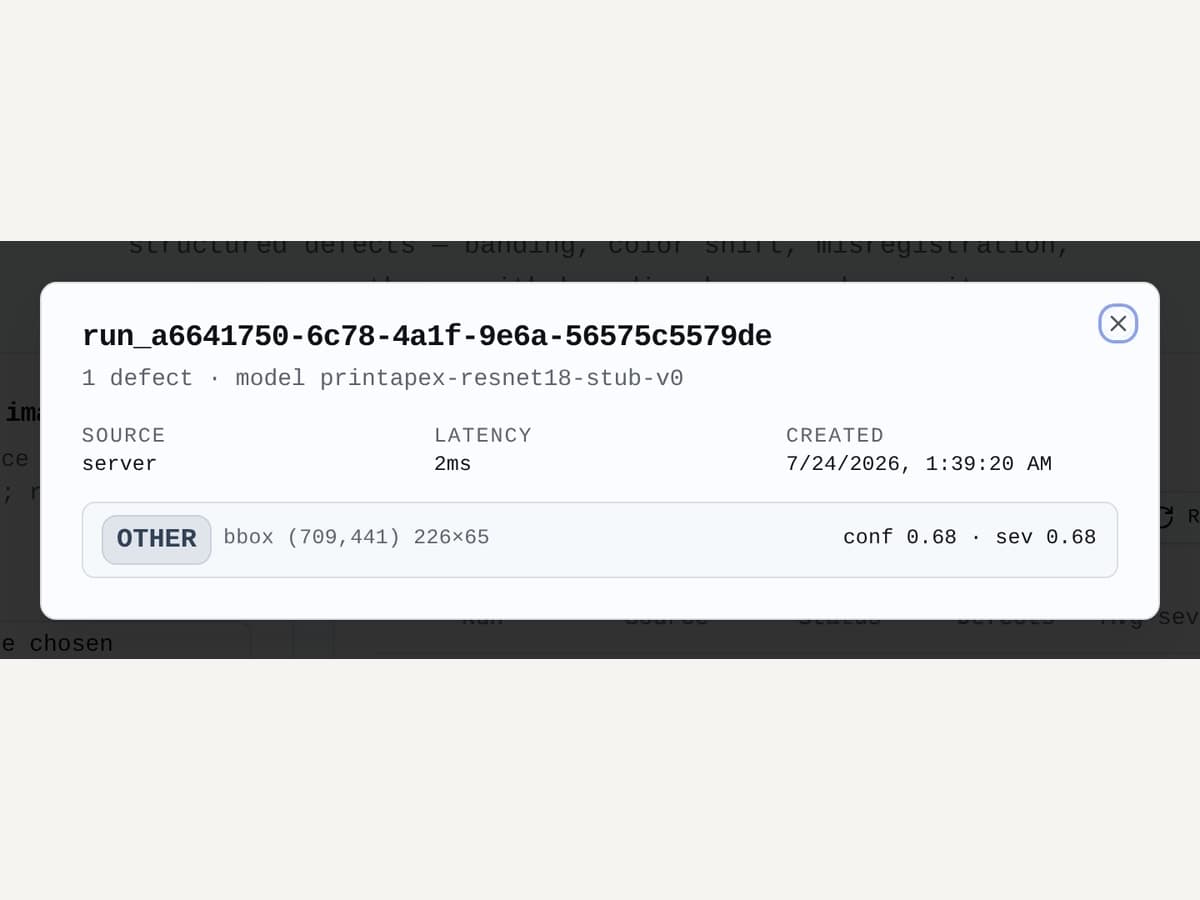
Real product capture · dashboard preview
- Autonomous monitoring
- 24/7
- Waste reduction
- ~35%
- Downtime cost neutralized
- $260K/hr
- Computer-vision defect detection
- 5-class
Detects banding, color shift, and misregistration on validated press samples.
Computer vision in action
What the model is actually looking at.
Four buyer-facing labels backed by a five-class output. Each of the cells below is a defect the model knows how to score — and exactly what the on-floor operator sees queued on the dashboard the moment one is flagged.
Banding
banding
Periodic stripes repeating down the roll.
Color drift
color_shift
Channels fall out of gamut mid-run.
Missing nozzles
misregistration
Blank streaks or registration slips.
Substrate contamination
smear
Smears from dust, fiber, or feed jitter.
| Run | Printer | Defect | Sev | Status |
|---|---|---|---|---|
| R-2418 | Press A | banding | high | Assigned |
| R-2417 | Press B | color_shift | med | Open |
| R-2415 | Press A | misregistration | high | Open |
| R-2412 | Press C | smear | low | Resolved |
Dashboard preview · what the on-floor operator sees
Buyer labels map to the model's five-class output: banding · color_shift · misregistration · smear.
How it works
From box-mount to dashboard in three steps.
One edge device on the press, one model scoring each frame, one dashboard the on-floor operator already uses. Real product capture — no stock illustration.
A single device bolts onto the press — no rip-and-replace, no PLC rewrites.
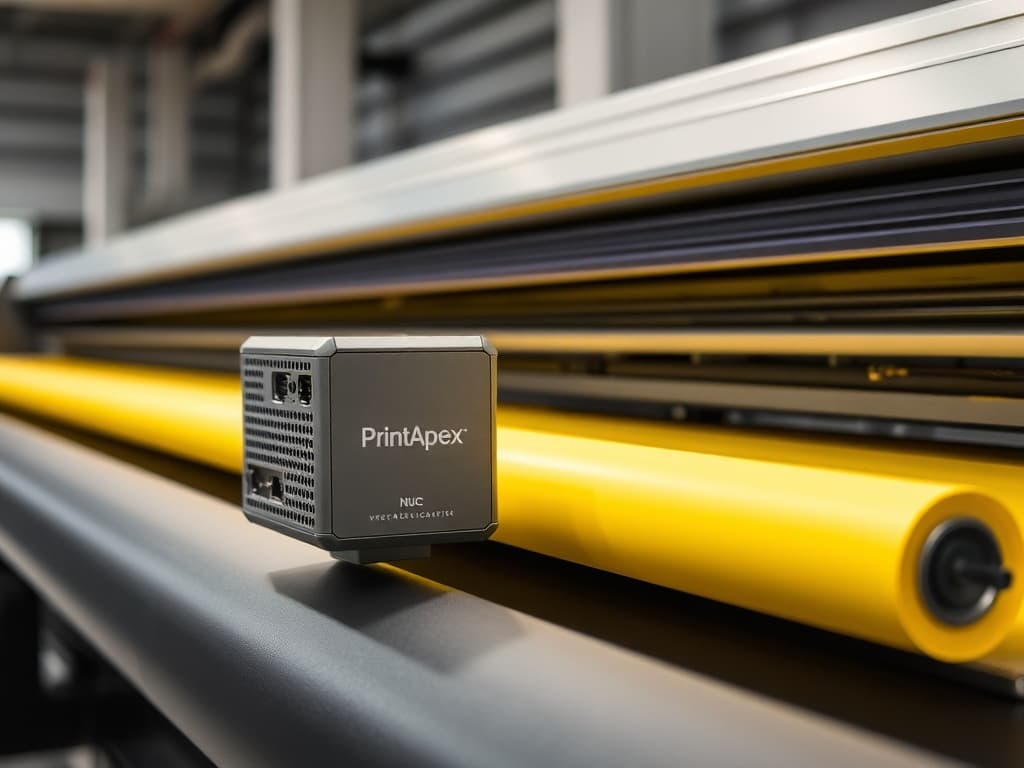
Real product capture · dashboard preview
Each frame is scored for banding, color shift, and misregistration as the print runs.
Real product capture · dashboard preview
Operators see defect popups and auto-generated work orders across the fleet.
| Run | Printer | Defect | Sev | Status |
|---|---|---|---|---|
| R-2418 | Press A | banding | high | Assigned |
| R-2417 | Press B | color_shift | med | Open |
| R-2415 | Press A | misregistration | high | Open |
| R-2412 | Press C | smear | low | Resolved |
Dashboard preview
Live mockup · scroll in
banding flaggedSee the alert before the roll winds.
A single ResNet-18 sweep reads ink levels and surfaces banding the moment the press drifts. Same shape as the on-floor operator dashboard.
How PrintApex works
How PrintApex works. Three steps.
From box-mount to the factory running itself — the floor in three moves.
Edge boxes bolt onto the presses — no rip-and-replace, no PLC rewrites.
A single ResNet variant inspects every frame and routes defects the moment they appear.
Roll-to-roll waste drops, work orders surface in the dashboard, the floor keeps running. Talk to us →
Capabilities
Three contracts, one data plane.
An image lands in the camera capture pipe or arrives from the RIP feed. Inference whichever way is configured for that lane — the defects stay the same shape, the alerts stay the same shell.
PNG / JPEG / WebP · up to 25 MB / image.
Five-class output: banding · color_shift · misregistration · smear · other.
Dead-letter on retry exhaustion — failure is loud, not silent.
Live preview
Track your prints!
Each account sees its own detection feed: defect type, severity, bounding box, and the moment the run cleared. The dashboard renders it live; signed-out visitors see this empty state instead.
How it works
Capture → detect → alert. Three moves.
- Step 1Connect
Wire the camera or the RIP feed
Edge cameras stream frames as multipart uploads; RIPs call the device-side model and POST detections back to /api/webhooks/detections.
- Step 2Detect
Run the ResNet variant
Five-class output with bbox + confidence + severity. Returns in milliseconds on a single edge device; same shape on the server.
- Step 3Alert
Route by webhook or dashboard
Pages or production-line control systems subscribe to /api/webhooks and receive signed JSON payloads. The dashboard applet keeps the on-floor operator in the loop.
Wire the camera or the RIP feed
Connect · queued
Run the ResNet variant
Detect · running
Route by webhook or dashboard
Alert · dispatched
On-floor signal
Every job on the queue carries a signed envelope — re-routing a webhook at the press side takes one config flip, no queue restart.
Outcomes
Numbers the on-floor operator quotes.
Validated against mixed RIP workflows and synthetic defect fixtures. Numbers below bound the MVP; raising them is a measurement cycle, not a product rewrite.
- Detection accuracy
- 95%+
- Edge footprint
- < 200MB
- Webhook retries
- 6×
- Payload signing
- HMAC
Banding, color shift, misregistration on validated print samples.
Single device, single GPU or even CPU — no data center required.
Exponential backoff up to six attempts before moving to dead-letter.
Every outbound alert ships with X-Polsia-Signature — verify on your side.
Production-ready
Built for the contract terms print ops already expect.
The MVP ships a stub inference path so the full data plane — uploads, persistence, webhook dispatch, ack, dead-letter — renders end-to-end today. Swapping in the real ResNet weights is a single file change at src/lib/business/detection/inference.ts.
Deterministic explicit contract
zod for every payload — client, edge device, server, cron all parse the same shape.
Owner-scoped resource gating
better-auth gates every /api route; webhook deliveries tag the subscribing userId.
Sign-once webhook secrets
HMAC-SHA256; X-Polsia-Signature is the only identifier a consumer needs.
Bounded retries, loud failures
Six attempts with exponential backoff, then dead-letter — never silent.
Pricing
Simple, transparent pricing.
Most operations see ROI within the first 30 days.
Real-time health monitoring on every press. Catches offline devices, low ink, low media, and stalled jobs before they become missed-shipment days.
3 printers · Entry-classSave $3,000–$10,000 / day in avoided downtime
- Real-time monitoring on every printer
- Standard alerts (offline, low ink, low media)
- Material waste ratio tracking
- Email + dashboard alerting
Adds AI defect detection to every print — banding, color shifts, misregistration — flagged at 95%+ accuracy so the operator catches them mid-job, not on the customer call.
3 printers · Mid-classSave $3,000–$10,000 / day in avoided downtime
- Everything in Starter
- AI defect detection on every print
- Per-image defect history + replay
- Workflow integrations (RIP / MIS handoff)
- Priority email support
Predicts component failure 14 days out, balances load across the fleet, and ships a dedicated CSM with a contractual uptime SLA. For 24/7 production floors running multi-site rollouts.
3 printers · Pro-classSave $3,000–$10,000 / day in avoided downtime
- Everything in Vanguard
- Predictive maintenance windows (14-day horizon)
- Fleet heatmap + load balancing
- Multi-site consolidated reporting
- Dedicated CSM + uptime SLA
FAQ
Questions buyers ask before the demo.
Short answers to the questions we usually hear in the first call. For anything contract-specific, we can scope it live.
Get in touch
Ready to put PrintApex on your floor?
Sign in to upload a few print images and watch the feed fill in, or write to us for a fleet audit. We'll review your RIP workflow and scope a pilot around your real defect rate.